Showing posts with label Hagal Farm. Show all posts

Friday, April 15, 2011

Irish hills on fire with Molinia caerulea 'Purple Moor-grass'


Driving down to the home place in West Cork is always a treat, especially if I haven’t been home in a while. Living in the city of Dublin now when I drive out the country roads I appreciate all the scenery more.


On my last trip down the back roads to Hagal Farm the hills looked on fire with the amazing golden glow of the Molinia caerulea commonly known as Purple Moor-grass (or uncommonly known by its Irish name ‘Fionnán’)


It’s spent seed heads and browned off blades gleaming gold in the spring sunlight look like flames.


This Irish native is quite widespread and locally abundant on permanently or seasonally wet ground as well as marshes and wet heaths and moors.


It was nice to stop and take it in as probably by the time I drive down to West Cork again it will all have transformed in to the lush green rolling hills that Ireland is so well known for.


On a more mundane note, this grass is also partially responsible for the rapped spread of hill fires that plague the country around this time of year. (In this case, the hills quite aptly ‘on fire with Molinia caerulea 'Purple Moor-grass')

Ulex-europaeus 'Gorse'
Many of these fires are started by farmers burning off Ulex europaeus ‘Gorse’ or by it Irish name Aiteann gallda. Unfortunately too often these fires spared out of control, overwhelming entire mountains and destroying wildlife and property in its wake. Worryingly, fire officers believe up to a quarter of these fires are set by arsonists.
According to a recent post in the Irish Examiner, last year, was one of the worst on record for such fires in Ireland, with Irish forestry’s ‘Coillte’ reporting damage to thousands of acres of forestry last year, three times in excess of the annual average.


Gorse fire near Baltimore
 [picture from The Southren Star]
 The annual burning season runs from February to May, even though it is against the law to start these fires between March 1 and August 31, may fires continue to be lit. In the wake of last years record high fires, new measures have been put in place. Issued jointly by the Department of Agriculture, An Garda Síochána, Teagasc, the Forest Service and the Irish Cattle and Sheep Farmers’ Association, a notice says severe penalties may be imposed on farmers who break the law, including loss of their Single Farm Payment. They can also be liable to fines of €1,900, or imprisonment, and county councils can charge property owners for fire brigade call-outs.

Oh look how nicely my post started out, hope I didn’t end up bumming you out. On the plus side, hopefully these new measures will see increased beauty and wildlife throughout these parts at this stunning time of the year.

scorce http://www.irishexaminer.com/opinion/columnists/donal-hickey/illegal-gorse-fires-still-burning-issue-151009.html

Saturday, March 5, 2011

Snowdrops, Labyrinths and their effects on Alzheimer's

The other day I was talking about snowdrops and their link to the treatment of Alzheimer's. The little snowdrop has been linked to an important medicine that could help in the treatment of Alzheimer's disease. Galantamine, a medicine used today to treat Alzheimer's disease, occurs naturally in several members of the amaryllis family (snowdrop; narcissus; daffodil). This important medicine was first discovered in the innocent Snowdrop. 

Snowdrops

Talking about this made me think of the living labyrinth in my parents' garden at Hagal Farm down in West Cork. (You may remember my post about this labyrinth last year.)

Labyrinth at Hagal Farm
 So why did snowdrops make me think of labyrinths, you ask?

More and more hospitals and wellness centres are using labyrinths in the treatment and care of Alzheimer's sufferers. The beauty of a labyrinth (often confused with a maze, which has many paths and dead ends) is that a labyrinth is a single winding path that leads from the entrance to the centre and back out again. All labyrinths are unicursal, meaning they only have one path, which makes them a perfect place for an Alzheimer sufferer to ‘get lost in’. (for more information about labyrinths, check out my previous post about them http://tinyurl.com/gardenlabyrinth)

Labyrinth at Marianjoy Rehabilitation Hospital in Wheaton, Illinois

With Alzheimer’s, the mind begins to short circuit. Performing tasks that once were as natural as breathing becomes a source of frustration. Confusion begins to crush hope. The caregivers for early- to mid-stage Alzheimer's residents know that these misfires aren't going to go away.
Back at home in West Cork a dear friend of our family has been suffering from Alzheimer’s for a number of years now, so I can begin to understand the heart wrenching, problems and difficulties of those who suffer from Alzheimer’s and the family and carers who lovingly look after them. It also gives me huge respect for those who live with Alzheimer's, as well as for their family and carers.

While reading up about this subject I came across a very interesting blog by a man called Chuck Donofrio. Chuck’s blog is called ‘Early onset Alzheimer’s Adventure
Chuck suffers from Alzheimer’s but as he states on his blog ‘Early onset Alzheimer’s diagnosis doesn't stop this "sufferer" from blogging about his day to day observations and feelings.
In one of his posts he writes the following about wanting a labyrinth “One of the most profound meditative experiences available to the lay person, or any other soul desiring a respite from the banality and meaninglessness of our daily round, can be found as near as the closest Labyrinth. The ancient practice of walking the "maze" has captured many a soul, most probably because the physical action of its twists and turns, coinciding with the step and breath of the human in motion, excites, even as it calms.”

The spiritual discipline of the labyrinth involves a "walking meditation" and is a metaphor for the soul's spiritual journey. It quiets the mind and opens the soul to a sense of wholeness and wellness. The tradition of labyrinth walks was recovered in the United States in the early '90s at Grace Cathedral in San Francisco and, in recent years, the labyrinth has come to be recognized as an instrument of holistic healing. The Rev. Canon Lauren Artress of Grace Cathedral has used labyrinth walks with groups of children with ADD/ADHD (attention deficit disorder/attention deficit hyperactive disorder) and has discovered that it helps focus and quiet them in a way that cognitive therapies fail to do.

Since many of the labyrinth projects are still new, they haven't completed any long-term studies. But many places have noticed that this ritual provides benefits such as short-term calming, relaxation, and relief from agitation and anxiety in otherwise fragmented lives. The restorative and calming value of the walk can last from two to three hours, or longer.

I also read of another touching story of a couple that walked, hand in hand, through the labyrinth almost daily.  He was suffering from Alzheimer’s, and she was struggling with the confinement, stress, and isolation of being a caregiver.  She noticed that after a few weeks of their routine, he began to regain small skills. 

Another labyrinth that is very appropriate to mention here is this one made from seasonal bulbs (many of them from the amaryllis family that make Galantamine) at Cornell University, New York. I also like the idea of how at the end of the flowering season it just turns back to a lawn, only to reappear the following year.

Bulb Labyrinth Cornell University

See more about this labyrinth here.
Bulb Labyrinth Cornell University

Labyrinths are a fantastic place for anyone to go and relax and I highly recommend finding one and trying it out for yourself. To help you find the closest one to you check out the global labyrinth locator http://labyrinthlocator.com/.

For a list of Labyrinths at Hospitals, Health Care Facilities, Spas and Wellness Centers go to http://www.labyrinthproject.com/hospitals.html

Scorces   
http://findarticles.com/p/articles/mi_m3830/is_10_50/ai_79355490/pg_2/
http://www.thecabinpath.com/labrynth.html
http://www.medicinenet.com/galantamine/article.htm

Saturday, February 12, 2011

Theater in the garden


Garden Theatres
Although there are many grand Garden Theatres and huge impressive amphitheatres out there in the world, they are not something you find very often in normal residential garden design. They are however, something I like very much. So I will leave the many grand garden theatres and the huge impressive amphitheatres for another post for another day.
Today I am going to talk about the intimate and sometimes modest (but just as effective) garden theatre.  


Bonfire Garden, Hagal Farm
Growing up on my parents farm in West Cork, we had a garden stage, but as you can seen in the picture across, it is now quite overgrown and a little neglected (although this in itself gives it a certain charm)
The stage made up part of a bonfire garden and back in the day, there was many a party held here.
West Cork is well known for being full of fine food and culture, so back then there was no shortage of  fine musicians to prop up on the stage (these would often overflow onto the simple timber seating that surround the fire pit). To the left of the stage was a round concrete pad reserved for dancing.
At night the garden would take on a very different atmosphere, as you went from being in an open outdoor garden into what seemed like an intimate enclosed space. One got this sense of enclosure as the light from the fire illuminated the trees that surrounded and arched over the entire area, hiding all that lay beyond.
   
A lovely garden theater at the Everglades Gardens, Leura, Australia.
I also love this garden theatre I came across in the Everglades Gardens in Leura, set in the amazing surroundings of the Blue Mountains in Australia.
The golden pyrmont sandstone arch which forms the dramatic backdrop to the stage was originally the recessed entrance to the London Chartered Bank of Australia on Sydney’s George Street. The arch is flanked by tall hedges clipped formally to form the wings of the stage.

Author Shawna Lee Coronado's Garden Stage

Another one I like for its sheer simplicity and functionality is this one by author Shawna Coronado. On her blog ‘The Casual Gardener’ she wrote about how the answer to her garden dilemma was resolved by creating this lovely little garden stage.
It is also a great example of how you can create an interesting garden feature on a small budget.

When having a rainwater collection system installed in her garden, she was left with a huge mound of soil from when they dug the hole for the tank, and of course this soil had to go somewhere! She did not want it to go to landfill so she decided to make a feature out of it. Even on a tight budget she managed to create a lovely little feature out of it. The four large tiles make up the stage, which regularly features her 10 year old daughter performing her latest stage show. It is also a spot where a musician might perform during a garden party. You can see her post about this here http://thecasualgardener.blogspot.com/2010/12/how-i-transformed-mound-of-dirt-into.html

Mainly because of my passion for stone, one of my favourites is this here, at Dick Schwab’s Celebration Barn near Solon in Iowa.
This amazing amphitheatre has an impressive dry stone arch, built with Anamosa Limestone from near Stone City, and has an impressive internal radius of 16ft (4.8m) weighing in at about 65 tons.
 The celebration barn often hosts weddings, the ceremonies often held underneath the mighty arch.


The stone arch and amphitheater at the Celebration Barn, Solon, Iowa. Photo by Eric Whittlesey
The arch and amphitheatre were built by ‘Country Stone Masons’. Fellow Stone Foundation member Eric Whittlesey who works for ‘Country Stone Masons’ told me a bit about the construction process, and was nice enough to share these photos as well.

Photo by Eric Whittlesey

The curved seating of the ampitheatre itself is also made with Anamosa Limestone, each stone meticulously chiselled to fit tightly to its neighbour. The area can seat over 300 people.

Photo by Eric Whittlesey

Photo by Eric Whittlesey

All 68 stones that make up the arch, some weighing as much as 1.5tons, had to be painstakingly carved into the angle of the arch.
On of the most fascinating thing about stone arches is the physics behind them, and the fact that the procedure to build them has hardly changed since Roman times back in the 10th century.
The shear downward force of weight (all 65 tons of it) combined with the angles of the wedge shaped stones or ‘voussoirs’ means that the stones are almost welded together, evenly spreading the weight down both sides. 

For these reasons the arch does not require any mortar to hold it together, however for peace of mind the stones were pinned together so that the masons could sleep soundly without having any nightmares about brides tragically being crushed by stones on their wedding day! 

Completed arch with form still in place. Photo by Eric Whittlesey

For the form that supported the arch as they built it, they used massive cotton wood timbers, which were stacked on top of each other as the build progressed. Then when the key stone was set in place, the most anticipated part of the build could be performed, this of course being the removal of the support form. I remember removing the form from the first large arch I built. As I was pulling it out, my brain kept telling me 'Of course it will stay up, there is absolutely nowhere it can go’  however its still a nerve-racking moment!

The stone arch and amphitheater at the Celebration Barn, Solon, Iowa. Photo by Eric Whittlesey

Monday, August 23, 2010

Fuchsia magellanica, West Cork's adopted alien.

During the summertime it is particularly a pleasure to drive down to the homestead down in West Cork. After spending many hours in the car, travelling on the wide motorways from Dublin, the narrow winding, pothole infested roads of the countryside are a welcome sight. The roads are about half the width they normally are in the winter as all the plant life competes for space. Although the roads are narrower, they do look fantastic as the glow with colour. And none glows with as much dominance as the fantastic Fuchsia.


We have a lot of aliens down in West Cork, they all seem to love the mild moist climate that we have thanks to the North Atlantic drift. Now before you send Mulder and Scully down here, let me clarify, I am of course not talking about the bright green kind that fly around in space craft, I am talking about plants that are not native to this country.

Red Fuchsia hedges with the orange glow another much loved and plentefull alien to Ireland Montbretia 'Crocosmia x crocosmiiflora'

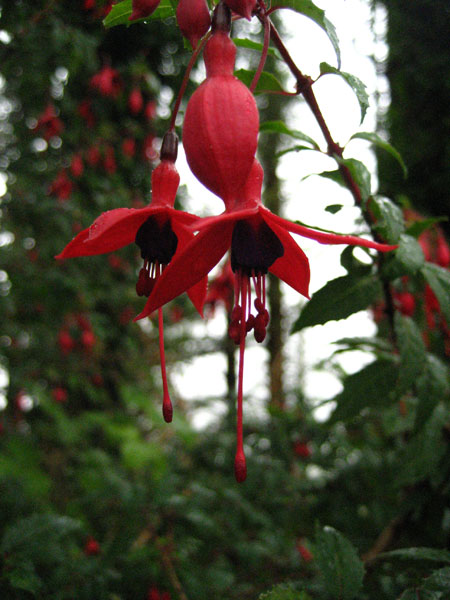
Fuchsia magellanica 'Riccartonii', or more commonly known as the Humming bird fuchsia or lady’s eardrops is an icon of West Cork. Anyone who has visited West Cork in the summer time will have seen this amazing deciduous shrub illuminate the hedge groves all over the countryside. It is so iconic of west cork it image is used by many local companies and organizations.


A native of Chilli, it was identified by Charles Plumier in the seventeenth century. Plumier named it after the German botanist, Leonhart Fuchs (1501-1566)


Fuchsia bark

This deciduous shrub will reach from about 1.5m to 2.5m high, and will favour coastal locations and rocky ground. Its flowers colour the hedgerows from July to October with their rich hues. The flowers (2cm long) are bell-shaped and have four violet petals which are surrounded by four large, pointed red sepals, rather like a ballerina with a crimson skirt, purple petticoat and long, slightly uneven, legs. The grey/green leaves are ovate and toothed and the fruits are black, fleshy berries in autumn. It should be noted that the black, fleshy berries of the Fuchsia are NOT edible. The branches of the fuchsia turn a pale, golden brown with age and its bark gets a lovely papery quality to it.


Fuchs ia magellanica 'Riccartonii'on frouunt of the White variaty, Fuchsia magellanica var. molinae (F. magellanica 'Alba')

If you would like to plant Fuchsia as an informal hedge, plant them 45cm (1.5 ft) apart in the spring. I mild areas like here in West Cork, Fuchsia magellanica can be grown quite easily through propagation, simply by taking cuttings from a mature plant in late autumn when the stalks are bare, and sticking them about 15cm into the ground.
Fuchsia flowers best on new wood so prune hard in spring, leaving just 15cm to 30cm (6in to 12in) of stem, from which new growth will shoot. Plants grown as hedges should be less severely pruned, although a portion of any old that may have been killed by frosted should always be removed.

The Drive up to Hagal Farm

Here in Ireland we all are accustomed to a few dreary summer days, and even though it was one of these kinds of days when I was out taking these photos, the vibrant colours of the Fuchsia still keep the place looking hot and summery.


Throughout the summer, the Fuchsia continues to make new flowers, while the older flowers fall to the ground leavening just the small berry behind. As a result of this, by this time of the year you begin to see these lovely red carpets at the base of the plants.


This Fuchsia is also popular with kids, as the flowers contain a pouch of sweet nectar. As kids we would often have purple and red lips as a result of drinking the nectar. The process you use to do this is, when you pick the flower, pull off the purple petals and stalks, hold the part where the petals were, up to your lips and squeeze the back of the flower to release the nectar.

Fuchsia high up in the hills, with the faint silhouette of O'Donovan castle in the distance.


Monday, May 17, 2010

Garden Piano


A few weeks ago when down visiting my parents at our family home, down in West Cork, I went for a wander in the gardens (you may remember these gardens from my previous post ‘'garden labyrinth’). During my wander I stopped off to have a look to see how the garden piano was doing.
By now it has all but disintegrated, but it still holds a magical charm about it, in fact it was all part of the plan! Perhaps I should explain.


Besides being a passionate gardener, my dad is also a passionate piano player, so a few years back we got him a new piano for his birthday. So the old piano spent a wile in the shed before he had the great idea to put it out in the garden. I can almost see one of Bruno Torfs sculptures sitting there playing it when no one is around (The first picture is my photoshopped impression of this)  


Tucked away in a inconspicuous corner, the piano creates a entire atmosphere of its own. Slowly over time it began housing plants and wildlife alike, becoming part of the landscape. Although it quickly lost its ability to play any notes, my dad was hoping to wake up one morning to a loud clang, when the piano would finally fall apart, making its final encore.


Unfortunately it never did produce the theatrical clang he was hoping for, it did on day just fall apart, creating a new and in some way far more enchanting garden feature.


Unfortunately as I was not there when the piano was moved, I don’t have any photos of this. The first few photos were taken in 2008 by a guest staying at my parents farm, and the rest were taken a few weeks ago on my resent visit.
Ping your blog, website, or RSS feed for Free
My Ping in TotalPing.com
Feedage Grade C rated
Preview on Feedage: trendy-trend-home Add to My Yahoo! Add to Google! Add to AOL! Add to MSN
Subscribe in NewsGator Online Add to Netvibes Subscribe in Pakeflakes Subscribe in Bloglines Add to Alesti RSS Reader
Add to Feedage.com Groups Add to Windows Live iPing-it Add to Feedage RSS Alerts Add To Fwicki